Project Structure
This page explains how the unified LimeSDR gateware project is organized across its two main repositories:
LimeSDR_GW – the top-level LiteX-based SoC project
LimeDFB – the reusable VHDL signal-processing library
Together, these repositories separate system integration from signal-processing logic. This keeps the design modular, reusable, and portable across multiple FPGA families and SDR platforms.
At a Glance
Repository |
Primary role |
Main contents |
|---|---|---|
|
System integration and build flow |
Board definitions, LiteX targets, SoC integration, firmware, bitstream generation, documentation |
|
Reusable signal-processing library |
VHDL DSP blocks, LMS7002M-related modules, AXI-Stream utilities, architecture documentation |
In practical terms:
LiteX provides the SoC construction framework
LimeSDR_GW defines how a specific board is built and assembled
LimeDFB provides reusable RF and DSP building blocks
This organization replaces isolated board-specific HDL projects with a shared and maintainable development model.
LimeSDR_GW Repository
The LimeSDR_GW repository is the main integration layer of the project. It is responsible for board support, SoC construction, firmware integration, and FPGA build flow management.
Repository layout
/ (root)
├── boards/
│   ├── platforms/
│   └── targets/
├── docs/
├── firmware/
├── gateware/
├── riscv_jtag_tunneled.tcl
├── README.md
└── .gitignore
Important directories
boards/platforms/Board-specific platform definitions, including FPGA device selection, pin assignments, and timing or toolchain constraints.
boards/targets/Top-level build targets that assemble the LiteX SoC for a specific board. These files define clocking, CPU integration, memory layout, peripherals, and optional features.
gateware/Custom FPGA logic and integration wrappers. This includes LiteX-facing wrappers for external HDL modules and project-specific hardware components.
firmware/Firmware for the softcore CPU, including low-level drivers and board-independent application code.
docs/Sphinx documentation, including build instructions, architecture notes, and developer guides.
Typical role in the build flow
LimeSDR_GW is the repository you work in when you:
build gateware for a supported board
modify SoC integration
add or configure peripherals
compile firmware
add support for a new platform or target
LimeDFB Repository
The LimeDFB repository contains reusable VHDL signal-processing modules used by the unified gateware project. It is designed to remain modular and largely vendor-neutral.
For complete module-level documentation, see the LimeDFB documentation.
Repository layout
/ (root)
├── axis/
├── axis_fifo/
├── cdc/
├── docs/
├── gt_channel/
├── lms7002/
├── rx_path_top/
├── tx_path_top/
├── README.md
└── .gitignore
Important directories
rx_path_top/andtx_path_top/Top-level receive and transmit processing chains.
lms7002/LMS7002M-related digital interface and control modules.
axis/,axis_fifo/,cdc/Shared infrastructure modules such as AXI-Stream helpers, FIFOs, and clock-domain-crossing components.
docs/Architecture overviews, diagrams, timing illustrations, and module documentation.
Typical role in the build flow
LimeDFB is the repository you work in when you:
develop or modify reusable DSP blocks
update RF data-path modules
improve shared VHDL infrastructure
verify signal-processing building blocks independently of board-specific integration
How the Repositories Work Together
The two repositories are connected through a wrapper-based integration model:
LimeDFB contains the reusable VHDL modules and LiteX wrappers
LimeSDR_GW contains the LiteX-based SoC and board integration
This allows the same signal-processing logic to be reused across different FPGA vendors and boards, while keeping the SoC assembly flow consistent.
Typical examples include:
LimeTopinstantiating receive, transmit, and LMS7002M-related blocks through LiteX-compatible wrappersfirmware accessing control and status registers through a consistent memory map
the same hardware design being built with Vivado, Quartus, or Lattice-based flows without redesigning the DSP modules
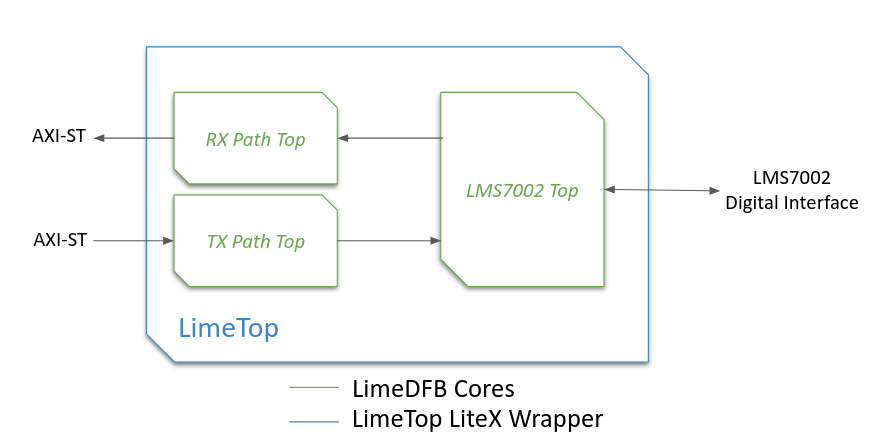
Example of LiteX and LimeDFB integration inside LimeTop. LimeDFB cores implement the RF processing logic, while LiteX wrappers connect them to the SoC infrastructure and control path.
Other Important Files
File |
Purpose |
|---|---|
|
Helper script for JTAG-based debugging of the RISC-V softcore. |
|
High-level project introduction and links to the main documentation. |
|
Defines generated files and build outputs that should not be tracked by version control. |